
Concho County Court Records After Arrest
An arrest record and a court record answer different questions. A booking profile can show who was taken into custody, the arresting agency, the booking date, initial charge text, and a bond figure. The court record shows what prosecutors filed, which court has the case, what settings are scheduled, whether a charge was amended or dismissed, and how the case ended. In Concho County, that split matters because TCJS reports no local county jail roster. The custody side may be in sheriff records, VINELink, or a receiving jail such as Tom Green County Detention Center, while the filed-charge side belongs to court and clerk records.
For custody and booking fields, use Concho County jail inmate records. For booking photos, use Concho County jail mugshots. Court records after a jail arrest are the better path for charge status, case numbers, court dates, warrants issued by a judge, disposition, and later expunction questions.
Find Concho County Court Records
The local search path begins with county court and clerk sources. Concho County links an online records portal through LGS, and the county site publishes county clerk and district court contact pages. A statewide search through re:SearchTX can help when a record is indexed there. Texas DPS conviction name search is a separate criminal-history route for conviction information, not a live jail roster and not a complete pending-case index.
- Use the Concho online records portal linked by the official county site.
- Check the Concho County Clerk page for local record routing.
- Use the Concho County district court page for district-court contact.
- Search re:SearchTX for statewide court-record access where available.
- Use Texas DPS conviction name search only for conviction-history research.
- Request offline records through the clerk or the Concho County public-information process.
The Concho online records portal screenshot is from the county-linked LGS search route. It is the local portal to check before moving to statewide tools.
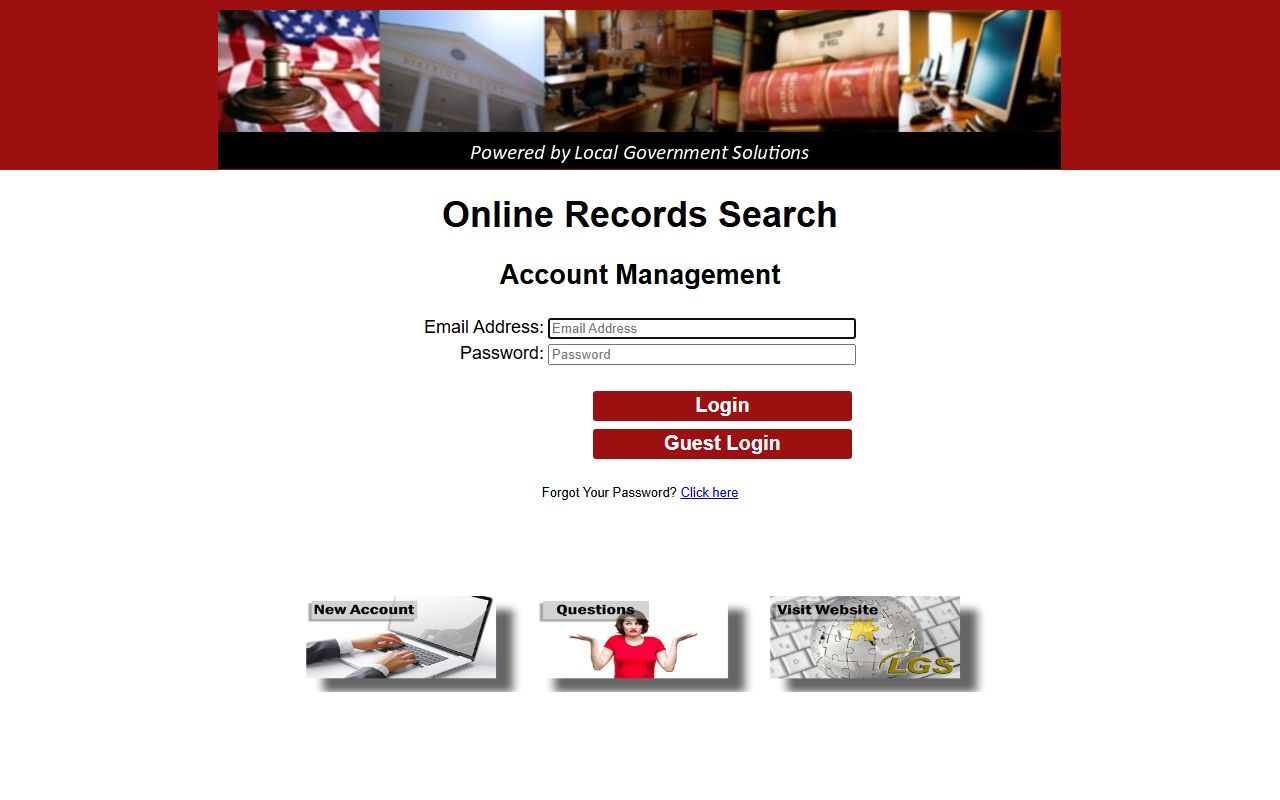
Portal access can depend on record type, case status, payment rules, and whether the clerk has made a document available online.
Concho County Court Search Fields
The research captured the official search routes, but not a full stable field inventory for every LGS court-record screen. That means the practical field set should be treated as portal-dependent. Use exact names and case numbers where possible, then contact the clerk when a search result is unclear or missing.
| Search Route | Likely Inputs | Best Use | Access Note |
|---|---|---|---|
| Concho online records / LGS | Name, case, document, or record-type controls depending on portal section | County-linked case and record lookup | Some records may require clerk contact or payment |
| County clerk | Name, case number, date, record type | Local criminal, probate, civil, or record routing as assigned by office | Call or use county instructions for records not online |
| District court | Case number, party name, court setting details | 119th District Court criminal-case follow-up | Use for felony-level district-court route |
| re:SearchTX | Party or case search depending on account and access | Statewide court-record search | Access varies by record and user role |
| DPS conviction search | Name-based paid public conviction search | Final conviction-history check | Not a pending court docket or jail roster |
Charges After a Concho Arrest
The arrest-to-court path usually moves from law enforcement to magistrate review and then prosecutor filing. A deputy or officer may list initial booking charges. A prosecutor then decides whether to file a complaint or information, present a felony to a grand jury, amend the charge, or decline part of the case. The court record is the place to verify the filed charge, not just the charge text shown on a roster.
| Document | Who Uses It | What It Does |
|---|---|---|
| Complaint | Law enforcement or prosecutor | States an accusation and can support early court action. |
| Information | Prosecutor | Formally files charges without a grand-jury indictment where allowed. |
| Indictment | Grand jury | Charges a felony after grand-jury presentation. |
Concho County Charge Status
Charge status can change after arrest. Booking charges may be amended, reduced, dismissed, or replaced by formal filed charges. A receiving jail profile can lag behind the court docket. The court or clerk record should be checked for the current case status, court settings, motions, and disposition.
| Status | Meaning |
|---|---|
| Pending | The case or charge is active and has not reached final disposition. |
| Amended | The filed charge was changed by prosecutor or court action. |
| Reduced | The charge moved to a lower offense level or lesser charge. |
| Dismissed | The charge ended without conviction on that count. |
| Acquitted | A not-guilty finding ended the charge. |
| Convicted | A plea or finding resulted in conviction. |
| Deferred adjudication | A Texas disposition that may avoid final conviction if completed, but records can still exist. |
Bond After Jail Arrest
Texas bond law is governed primarily by Code of Criminal Procedure Chapter 17. After arrest, a magistrate reviews the accusation, gives required warnings, and sets bond if release is legally available. In a Concho case housed outside the county, the holding facility may be the place to verify current bond, while the court record is the place to follow later bond changes.
| Bond Type | How It Works |
|---|---|
| Cash bond | The full bond amount is paid directly as security for appearance. |
| Surety bond | A licensed bail bond company posts bond for a fee. |
| Personal or PR bond | The person is released on promise to appear and court conditions. |
| Property bond | Property is pledged under court or clerk requirements. |
| No-bond hold | No releasable bond is available for that charge or hold. |
The Tom Green roster sample advised people posting bail to call detention staff at 325-659-6597 for correct bail amount, charges, and case numbers. That warning is useful for Concho arrests housed there because public roster fields can lag behind court action.
Warrants and Court Arrest Records
No official Concho County sheriff warrant-search page was located. Use the sheriff's office at 325-732-4312, the Eden Law Enforcement Center at 325-869-2222, and court or clerk channels for case-specific warrants and settings. The Tom Green County warrant route can matter if the person is held or wanted there, but Texas does not have one public statewide active-warrant database that replaces direct court or law-enforcement contact.
A warrant can lead to booking, transfer, magistrate review, and then a court record. A bench warrant or capias often comes from a judge after a missed court event. Search warrants are different because they authorize a search of a place or property, not a custody booking.
Charges Versus Convictions
Being arrested or charged is not the same as being convicted. A charge is an accusation that may be changed or dismissed. A conviction comes from a plea or finding of guilt. DPS conviction search can help with final conviction history, but it should not be used as the only source for a pending Concho County case.
| Charge | Conviction | |
|---|---|---|
| Stage | Accusation after arrest or filing | Final guilt outcome |
| Proof | Lower early-case standard | Verdict or plea process |
| Where to verify | Court docket, clerk, prosecutor filings | Court disposition and DPS conviction route |
Sealed and Expunged Arrest Records
Texas expunction is governed by Code of Criminal Procedure Chapter 55 when a person qualifies. Sealing and expunction are court processes. A dismissal does not automatically make every public copy disappear, and a private reposting is separate from the agency record. Use the court and clerk route to verify whether an order exists.
| Sealed or Nondisclosed | Expunged | |
|---|---|---|
| Public view | Public access is limited by court order. | Record is removed or treated under expunction rules. |
| Agency access | Some justice agencies may retain limited access. | Access is much more restricted. |
| How it happens | Court process, not a roster request. | Court process under Chapter 55 when eligible. |
Restricted Concho Court Records
Texas Government Code Chapter 552 starts from public access to government information, but exceptions can apply. Juvenile records, sealed records, expunged records, confidential identifiers, victim information, medical information, and active investigative material can be withheld or limited. Criminal-history handling is also governed by Code of Criminal Procedure Chapter 66.
Important: This resource is not a consumer reporting agency and cannot be used for FCRA-covered screening decisions.
Public Record Search
Sponsored Results